
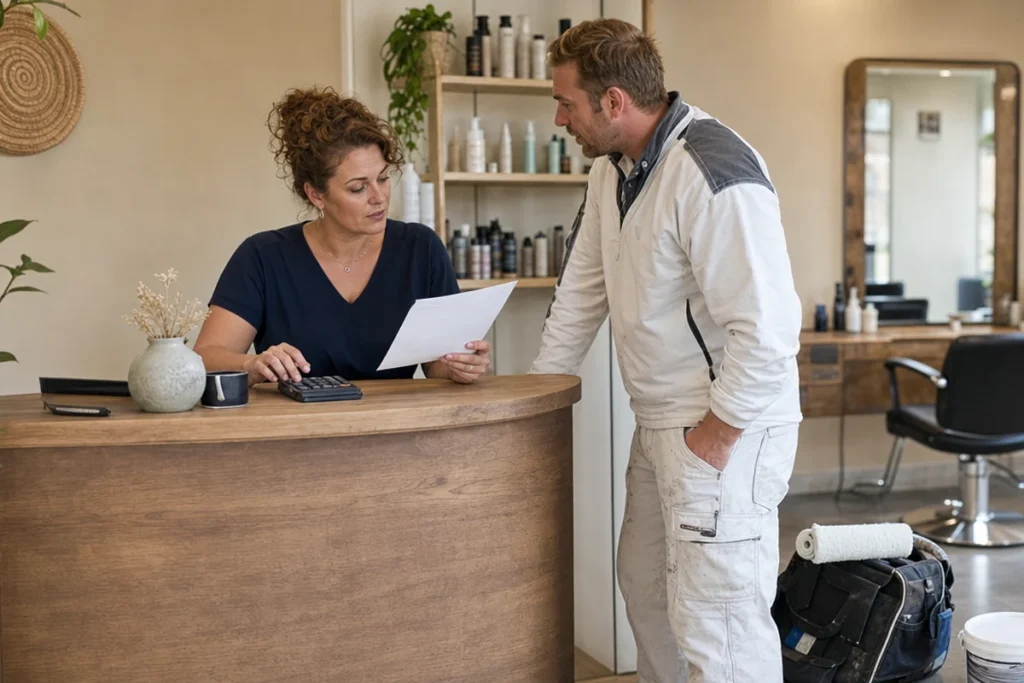
Painting a home, renovating a bathroom or running a hair salon? When setting your price, check which BTW rate applies to the particular service. In the Netherlands, the standard rate is 21%, while selected services qualify for 9%.[1] You may apply both rates even within one business. Classification depends on what you sell and the conditions of the particular transaction.[1][2][3]
BTW is Dutch VAT. The net amount is the price excluding this tax, while the gross amount includes it. The examples below are fictional, concern ordinary domestic transactions in the Netherlands and assume that the business operates outside KOR. Examples involving private customers assume that the reverse charge does not apply.
The short answer
The main BTW rates are 21%, 9% and 0%.[1] Exemption is a different treatment from the 0% rate: the main difference concerns the right to deduct tax on purchases.[1][12] A construction contractor must check the type of work and building, while a hairdresser must separate the service from sales of cosmetics.[2][3]
Key information
- 21% is the standard rate; you apply 9% when the service meets the conditions for the reduced rate.[1]
- Typical hairdressing services carry 9%, but separate sales of haircare products carry 21%.[2]
- Painting and plastering qualifying homes more than two years old carry 9%, including the materials used.[4][5][6]
- For insulation work on such a home, 9% applies to the relevant labour, while materials carry 21%.[7]
- “Btw verlegd” means that responsibility for accounting for the tax shifts to the customer. Do not enter a 0% rate for that reason.[10]
Construction: first check the scope of work and type of building
Ordinary construction and renovation work carries 21% BTW, apart from the specified exceptions.[3] For example, tiling, installing plasterboard walls and laying floors remain at 21%; the tax authority lists these as work separate from plastering.[6] The description “renovation of an old house” alone therefore does not justify 9% on the whole invoice.
For painting, plastering and the relevant insulation labour, check whether the property is a home intended for permanent occupation by private individuals.[4] Business premises do not meet this condition, and in a mixed residential and commercial building the preferential treatment applies only to the residential part.[4]
The home must be more than two years old when the work is carried out.[4] The period runs from the building’s first use as a home.[4] Belastingdienst indicates that you can check BAG data through Kadaster or obtain a written statement from the customer confirming the home’s age.[4] Keep this evidence with the job records. For a home built in stages, at least 50% of it must consist of parts more than two years old.[4]
Painting and plastering: materials also at 9%
Qualifying painting work carries 9%, including the materials used, preparation and preliminary treatment.[5]
Similarly, for plastering, the reduced rate covers preparation and the materials used.[6] This concerns materials supplied as part of that service; a separate sale of paint does not thereby become a painting service at 9%.[1][5]
Example. Adam paints a qualifying home more than two years old for a private owner. The agreed 1 000 euros net covers labour and the paint used during the work. BTW is 90 euros, so the customer pays 1 090 euros gross.
If Adam also replaces doors, that work carries 21%.[5] The breakdown should already be visible in the quotation and then on the invoice.[3] With fictional prices, the calculation is as follows:
- Painting at 9%: 1 000 euros net + 90 euros BTW = 1 090 euros gross.
- Door replacement at 21%: 2 000 euros net + 420 euros BTW = 2 420 euros gross.
- Whole invoice: 3 000 euros net + 510 euros BTW = 3 510 euros gross.
Do not automatically extend the 9% rate for painting to structural repairs. Replacing windows and frames is among the work the tax authority lists at 21%.[5]
Insulation: separate labour from materials
For insulation of floors, walls and roofs in a qualifying home more than two years old, 9% covers the labour for installing insulation material where the purpose is to improve energy efficiency.[7] Insulation materials carry 21%.[7] Demolition work before insulation also carries 21%.[7]
Example. Labour meeting these conditions costs 1 000 euros net: including BTW, that is 1 090 euros. Materials cost 800 euros net and carry 168 euros BTW, making 968 euros gross. The total is 2 058 euros gross. The example assumes there is no additional work requiring separate classification.
Cleaning a home has separate conditions
Ordinary cleaning inside a home qualifies for 9%, without the requirement that it be more than two years old.[3][8] Do not extend this rule to the whole cleaning industry. Cleaning the outside of a house and certain specialist services carry 21%.[8] The tax authority lists, among other things, cleaning chimneys and central heating systems, and cleaning after a fire.[8]
Hair salon: service and product on separate lines
Haircuts, washing, drying, colouring, shaving and beard trimming carry 9% BTW.[2] The rate includes products used during the treatment, such as shampoo or hair dye.[2] A bottle of shampoo sold to a customer to take home, however, carries 21%.[2]
On its hairdressers’ page, the tax authority classifies typical beauty treatments, make-up, manicures and pedicures as services carrying 21%.[2] Separate medical services need a separate assessment of any potential exemption; this guide alone does not determine their classification.
Example. Marta charges 35 euros gross for a haircut. At 9%, she divides this amount by 1,09. Rounded, the net price is 32,11 euros and BTW is 2,89 euros. Calculating 9% of the full 35 euros would give the wrong result, because that price already includes tax.
The same customer buys shampoo for 24,20 euros gross. At 21%, the net price is 20 euros and BTW is 4,20 euros. At the till, separate the service and product sale according to their applicable rates.[1][2] A package of services and goods requires you to establish whether it contains separate supplies; a single combined price does not determine the rate.[1]
Construction subcontractors and “btw verlegd”
For qualifying subcontracting involving physical work on immovable property, the reverse charge applies: the customer, usually the main contractor, accounts for BTW.[9] The fact that the customer runs a business is not enough on its own for this rule to apply.[9]
The subcontractor does not add tax. The invoice states “btw verlegd”, the customer’s BTW identification number and the consideration broken down by the rates that would apply without the reverse charge.[10] You therefore still need to establish whether the work corresponds to 9% or 21%.[10]
The rule has exceptions. For example, it does not cover design work or work carried out entirely, or more than 50%, in your own workshop.[9] For an ordinary job commissioned by a private homeowner, you charge the appropriate rate on your own invoice. Check an unusual arrangement between the parties before issuing it.
BTW on sales and purchases
Tax on business purchases, known as voorbelasting, can be deducted if the conditions are met.[12] The purchase must serve taxable activities or sales for which the tax is shifted to the customer; you also need a valid invoice and an actual supply.[12] Expenditure connected with exempt sales does not give the same entitlement.[12] Private use and other restrictions need to be checked separately.
Simplified accounting example. In a given period, Adam has 5 000 euros net of qualifying painting sales at 9%, giving 450 euros BTW. He bought paint for 1 000 euros net plus 210 euros BTW. We assume full use for this taxable activity, a valid invoice and no other adjustments. After deduction, 240 euros BTW remains payable. Different purchase and sales rates do not in themselves prevent deduction.[12]
The 0% rate: taxable sales with no tax amount added
At the 0% rate, sales remain taxable. The BTW amount on them is zero, but you retain the right to deduct tax on related purchases if you meet the conditions for deduction.[1][12] You apply this rate only to transactions for which there is a basis for doing so.[1]
A construction example: solar panels
The 0% rate can also apply to a domestic job: the supply and installation of solar panels on or near a residential building, provided the conditions are met.[14] Example. An installer supplies and installs ordinary on-roof panels on an existing house. The agreed price is 4 000 euros. With the correct application of 0%, BTW is 0 euros and the customer pays 4 000 euros.[14] An installer operating outside KOR can deduct qualifying BTW on purchases connected with these sales.[1][12]
The 0% rate does not automatically cover the entire roof conversion. Reinforcing the roof for the installation carries 21%.[14] If an installer or supplier only supplies or installs roof-integrated panels on a newly built home, the rate is 0%. If the same supplier delivers the entire newly built home with those panels, the 21% rate applies to the whole supply.[14]
The end of the net-metering scheme (salderingsregeling) on 1 January 2027 does not change these BTW rules. Dutch government guidance on solar panels and net metering.
An example of an international transaction is the export of goods outside the European Union. The seller must prove export using their records.[13] A fictional business sends goods from the Netherlands to a recipient in Switzerland and has evidence that they have left the EU. This supply may qualify for 0%.[13] The example concerns an actual export of goods, not a haircut for a foreign customer or renovation of their Dutch home. Collection in person, transport in luggage and supply chains require additional rules to be checked.[13]
An ordinary hairdressing or construction service in the Netherlands does not qualify for 0% simply because the buyer has a business.[1][2][3]
Check any potential reverse charge separately.[9] The absence of BTW added to an invoice does not in itself explain which mechanism has been applied.
BTW exemption: also check the tax on purchases
For exempt sales, known as vrijgesteld, you do not charge BTW. As a rule, you cannot deduct tax on purchases attributable to those sales.[1][12] If you make both taxable and exempt sales, the right to deduct must be determined according to how the expenditure is used.[12]
A hair salon does not become exempt simply because it offers treatments that improve appearance. Ordinary beauty services, manicures and pedicures carry 21% on the Belastingdienst page for hairdressers.[2] Do not classify a potentially separate medical service solely by the name of the treatment. Its status requires separate checking.
KOR is a voluntary exemption scheme
KOR is not a tax rate. A business can choose to participate if it meets the conditions; the domestic scheme covers businesses established in the Netherlands with turnover not exceeding 20 000 euros in each of two calendar years: the year of registration for KOR and the preceding year.[11] Low turnover alone does not replace registration for the scheme.[11]
A KOR participant does not charge BTW to customers and does not recover it on costs or investments.[11] Therefore, weigh the decision against your planned purchases. The same salon operating outside KOR can deduct qualifying BTW, whereas participation in KOR rules out that deduction.[11][12] Check the other conditions and the consequences of exceeding the threshold before choosing the scheme.
Example. Marta participates in KOR and buys a hairdryer for the salon for 100 euros net plus 21 euros BTW. She pays 121 euros and does not recover those 21 euros through her BTW accounting.[11] For taxable activities outside KOR, that tax may be deductible if the purchase meets the required conditions.[12]
How do you identify an invoice with no BTW added?
- Export of goods with documented export outside the EU: potentially 0%, with entitlement to qualifying deductions.[13][12]
- Exempt sales: no BTW charged and, as a rule, no deduction on attributable purchases.[1][12]
- A salon participating in KOR: exemption under the scheme, without recovery of BTW on costs and investments.[11]
- A qualifying construction subcontractor: “btw verlegd”; the customer accounts for the tax at the appropriate rate, and deduction depends on their entitlement.[9][10]
If in doubt, establish the basis for the treatment instead of entering 0% on every invoice with no tax added.
Frequently asked questions
Does the whole renovation of an old home carry 9%?
No. The preferential treatment covers specified services and conditions. Separate the remaining work according to the appropriate rate.[3]
Does shampoo used when washing hair have the same rate as shampoo sold to take home?
A product used during a hairdressing service is covered by 9%. A separate sale of a bottle carries 21%.[2]
Does a “btw verlegd” invoice mean there is nothing to account for?
The seller reports the relevant turnover, while the customer accounts for the reverse-charged tax. Deduction by the customer depends on their entitlement to it.[10]
What should you check before setting a price?
- Describe the specific work or service and any products sold separately.
- For the preferential treatment for homes, check the property’s intended use and required age.[4]
- Separate items at 9% and 21%; for insulation, also separate materials from labour.[3][7]
- Establish whether the price is net or gross.
- Check the conditions for “btw verlegd” or participation in KOR.[9][11]
- Keep documents supporting the rate and deduction.[4][12]
How can KFA help?
If you combine different types of work or sell both services and cosmetics in a salon, prepare a sample quotation and a description of your sales. Check how KFA Finanse services are priced and contact us about bookkeeping support. Before sending documents, agree on a secure way to transfer them.
Related guides
Sources and updates
Sources were checked on 13 October 2026. The text explains typical domestic situations, does not replace an assessment of a particular job and does not cover cross-border procedures. Next editorial and source review: 2 November 2026 (an editorial date, not a tax deadline), or earlier if official rules change.
- [1] BTW rates: 21%, 9%, 0% and exemptions
- [2] Hairdressing services and product sales
- [3] Work on homes: breakdown of rates
- [4] Homes more than two years old
- [5] Painting homes
- [6] Plastering homes
- [7] Insulating homes: labour and materials
- [8] Cleaning homes
- [9] Reverse charge for subcontracting
- [10] “Btw verlegd” invoices and accounting
- [11] KOR: exemption for small businesses · Eligibility and turnover threshold
- [12] Conditions for deducting BTW on purchases
- [13] Export of goods outside the EU
- [14] Solar panels: 0% rate and exceptions
This guide provides general information. The classification of a particular service, entitlement to exemption and the extent of BTW deduction depend on the circumstances of the transaction. Check before issuing an unusual invoice.
