
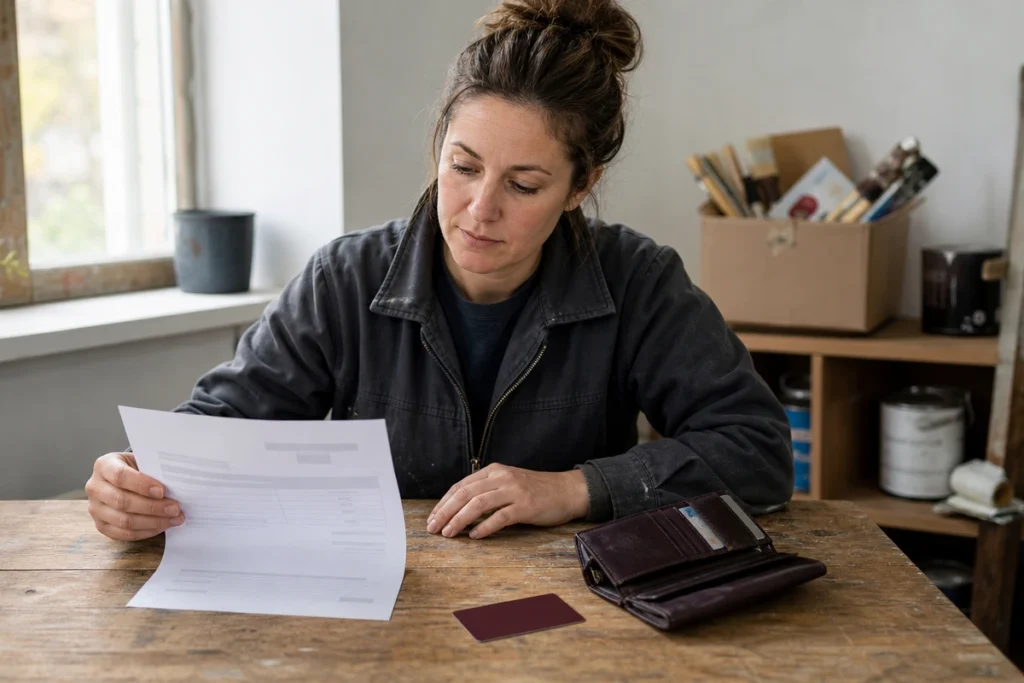
You buy materials for a job and pay with your personal card at the checkout. The invoice reaches your accountant, but the payment does not appear in your business bank account. Attach proof of the transaction and a short note explaining who paid and whether they have already been reimbursed. This lets your accountant match the purchase to the correct payment.
The short answer
Prepare the purchase document, proof of personal payment, an explanation of the business purpose and reimbursement details. Your accountant will check the expense itself and the deduction of BTW, the Dutch term for VAT, separately. Paying with a personal card does not, by itself, determine how the purchase is treated.[2][5][8]
Who is this guide for?
It is for the owner of a Dutch sole proprietorship, an eenmanszaak, referred to informally here as a ZZP business, and for a BV owner or director who has paid for a company purchase with a personal card. We cover an ordinary business purchase in the Netherlands. We do not determine the treatment of salaries, employee benefits, foreign BTW or an item originally bought for private use and later transferred to the business.
What to send your accountant: a practical checklist
This is a way to organise your documents, not a separate official form. For each purchase of this kind, prepare:
- The seller’s document. The complete invoice PDF or a legible purchase document, including every page. If you only have an order confirmation, ask for the invoice as well. State whether the purchaser was your sole proprietorship or a particular BV.
- Proof of payment. The completed transaction from your bank or card statement: date, amount, currency, payee and information identifying who paid. For a credit card, include the individual purchase entry, rather than only the combined card repayment.
- A link between payment and invoice. The document number and an explanation if the amount or seller’s name differs from the statement entry. Note whether the payment covered several purchases, an instalment or private items as well.
- The business purpose. Explain what was bought and how it is used in the business. If it is also used privately, describe both uses. Simply writing “for business” does not explain its connection with your work.
- Reimbursement status. State who paid out of their own pocket, whether they have been reimbursed, when and how much. Attach proof if reimbursement has taken place. If it has not, say so explicitly.
- Later changes. Include a credit note, details of returned goods or a refund from the seller. Also flag an invoice that has already been sent to your accountant.
Keep the original files. Send financial documents through the channel agreed with your accountant. Do not send a PIN, CVC, login details or the full card number. Agree how much of the statement is needed; a copy should not hide information required to match the transaction.
Example: materials for a job paid for with a personal card
This is a fictional situation, with no tax calculation. Marta buys materials solely for a job she is carrying out. She pays with her personal card and receives an invoice naming the correct purchaser. She sends her accountant the invoice, proof of the transaction and a note: “Materials for a renovation job. Paid with Marta’s personal card. Not yet reimbursed.”
If Marta operates an eenmanszaak, the accountant separates the purchase from the owner’s private funding.[1] If her BV is the purchaser, the documents also support settlement of the expense paid on the company’s behalf.[3] When Marta is reimbursed, she sends proof referring to the same invoice. In both cases, entitlement to deduct BTW requires a separate check; this example does not assume it.[5]
Key points
- Match the purchase document to the specific payment. Checking BTW also requires details of the purchase and the required document.[5][6]
- In an eenmanszaak, private funds contributed to the business are treated as a privéstorting, an owner’s contribution. The contribution itself is not business income.[1]
- A BV has legal personality and its finances are separate from the owner’s private finances. An expense paid on the company’s behalf needs to be settled between the company and the person who paid.[3][4]
- Settle reimbursement with the person who paid. Keep the purchase documents for the separate BTW check.[3][5]
Check the invoice and business purpose first
For an ordinary invoice with Dutch BTW, check:
- Seller and customer: their details and addresses, the seller’s BTW identification number and their KVK number if registered.
- Number and dates: the invoice number and date, and the delivery date.
- The purchase: the description and quantity of goods or extent of services.
- Amounts: the amount excluding BTW, tax rate and tax amount.
A trading name may be acceptable if it is registered with KVK together with the address and town.[6]
For a BV purchase, pay particular attention to the correct company being named as the customer. If the document names you personally even though the BV was the actual purchaser, ask the seller to clarify or correct the details. Do not edit the PDF yourself. Deduction also requires the goods or services to have actually been supplied to the taxpayer claiming it.[5][6]
Not every receipt needs all the details required on an ordinary invoice: separate rules exist, including those for simplified invoices. Show your accountant the document you received, rather than assuming every receipt is sufficient or none can be.[6]
Describe any private use too. For a sole proprietorship’s business expenses, deduction concerns the business portion, subject to the restrictions applicable to that expense. An expense with no business connection cannot be deducted from business profit.[2]
ZZP: a purchase paid for with the owner’s money
Belastingdienst, the Dutch tax authority, calls money or goods contributed from private assets to a business a privéstorting. This increases the business’s capital but is not, in itself, business profit or income.[1]
When you buy something for your eenmanszaak with your own funds, your accountant should record both the purchase and its private funding. Mark it “paid personally”, even if you do not intend to transfer money from the business account to your private account. This is a practical application of the distinction between a purchase and an owner’s contribution.[1][8]
If you later transfer money to yourself from the business account, identify the original invoice. Do not report the transfer as another purchase. Private withdrawals by the owner are not, in themselves, expenses that reduce business profit.[1]
Keep business and private payments separate in future. KVK advises sole proprietors to check their bank’s terms: many banks do not allow business use of a personal account.[8]
BV: settling money paid on behalf of the company
A BV is a legal person, and its funds are separate from the owner’s private money.[4] If you pay for an actual company purchase with your personal card, give your accountant the documents needed to settle the expense between you and the BV. Do not simply describe it as a private contribution to an eenmanszaak.
Belastingdienst gives the example of an owner paying a bill for their BV and being reimbursed promptly as a transaction through a rekening-courant. In the company’s books, the rekening-courant shows who owes money to whom: you to the company or the company to you. It is not your bank account.[3]
Prepare a short expense record: who paid, which invoice it relates to, the purpose and whether reimbursement has taken place. Once the treatment is agreed, reference the invoice or expense record in the reimbursement transfer. Your accountant should be able to settle the same entry rather than treat the transfer as another purchase.[3]
If the BV does not reimburse you for a longer period or these payments build up, ask for a separate assessment. Calling an entry “rekening-courant” does not establish that it is not a loan. Belastingdienst distinguishes short-term mutual settlements from funding that needs to follow the rules applicable to a loan.[3] This guide does not set loan terms or determine the tax treatment of other payments from the company.
BTW and the purchase cost need separate checks
For an ordinary domestic purchase with BTW, deduction requires, among other things, use for activities that give a right to deduct, an appropriate invoice showing BTW and an actual supply of the goods or services. For exempt or mixed activities, the extent of deduction may differ.[5] Paying personally or later reimbursing the owner does not replace these conditions.
The purchase itself also needs to be classified. Equipment used over several years may require depreciation, meaning the cost is spread over time. Goods bought for resale are a different category from equipment used in the business.[7] Explain whether you bought materials for a current job, goods for sale or equipment for longer-term use. The payment method does not determine how the purchase is recorded in the books.
Frequently asked questions
I only have proof of the card payment. Is that enough?
Proof of payment alone does not establish every condition for deducting BTW, particularly the required invoice details and what was supplied.[5][6] Ask the seller for the purchase document. If you cannot obtain it, give your accountant the available evidence for assessment, without assuming a deduction.
Should I pay the seller again from the business account?
If the purchase has already been successfully paid for, do not repeat the payment just to make it appear in the business account. Explain the personal payment and any reimbursement to the owner. If you do not know whether the transaction has completed, check its status with the seller or bank first.
Is an invoice in my own name always wrong?
No. The actual purchaser’s identity and the rules applicable to the document matter. An ordinary invoice names the legal entity or person, and may use a trading name under specified conditions.[6] For a BV, remember that the company is a separate legal person.[4] Have the document checked if the details are unclear.
Does reimbursement from a BV mean all the BTW can be deducted?
No. Reimbursement settles money paid on the company’s behalf. The right to deduct BTW and the extent of deduction depend on separate conditions concerning the purchase, its use and the invoice.[3][5]
How can KFA help?
Prepare the purchase document, proof of payment and reimbursement details. Contact KFA Finanse about the tax treatment of your purchase. State whether you operate an eenmanszaak or the purchase is for a BV, and which documents are missing.
Related guides
Buying equipment as a ZZP: expenses, depreciation and KIA and common ZZP business expenses.
Sources and updates
Official sources were checked on 18 November 2026. Scope: documenting personal payment for a business purchase and the basic differences between an eenmanszaak and a BV. An editorial review is planned before publishing guidance for the new tax year, or sooner if the cited guidance changes. This is not a tax deadline or a promise of continuous monitoring.
- [1] Private contributions and withdrawals
- [2] Business and private expenses
- [3] BV running account versus a loan
- [4] Legal personality and BV finances
- [5] Conditions for deducting BTW
- [6] Invoice requirements and exceptions
- [7] Equipment, stock and depreciation
- [8] Business payments and personal accounts
This guide provides general information. The final treatment of a purchase, settlement with the business owner and entitlement to deduct BTW depend on the documents and the specific circumstances. The checklist and fictional example do not guarantee that an expense is deductible or that tax will be recovered.
