
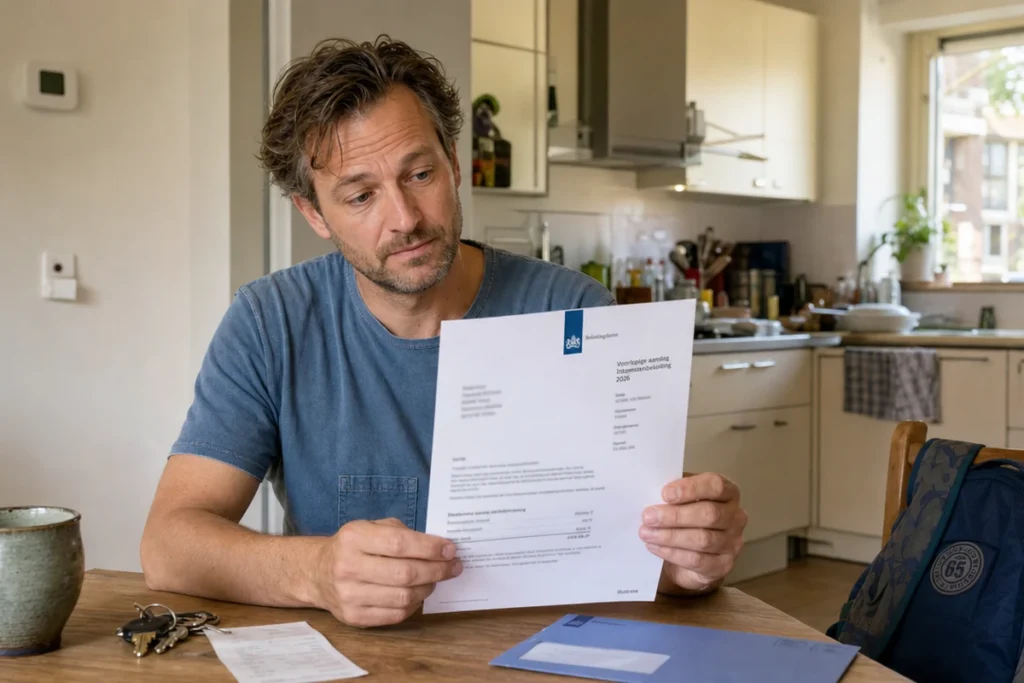
The short answer
You receive a letter from Belastingdienst showing a tax amount for a year that has not yet ended. How does the tax authority know how much you will earn? It uses a forecast. On that basis, it issues a voorlopige aanslag, a provisional tax assessment that allows you to settle tax during the year.[1][2]
You may receive one on the tax authority’s initiative or apply yourself, including through an authorised accountant.[2][5][16] Applying is voluntary, but you cannot simply ignore an assessment requiring payment.[2] If the tax authority has used outdated income figures, you need to report a change.[4]
This guide covers provisional payments of inkomstenbelasting — personal income tax — for 2026. It explains payments for the current year, not provisional corporation tax payments for a BV.
Key information
- A provisional assessment is based on an estimate. After the annual tax return, there may still be an amount to pay or a refund.[1][20]
- Belastingdienst may issue one without an application from you. Not having applied does not exempt you from payment.[2]
- You correct an inaccurate estimate by changing the provisional assessment. An ordinary objection, known as bezwaar, is not the appropriate first step.[14]
- Payments can be spread over a maximum of 11 instalments, but the later the assessment date, the fewer instalments remain.[7][20]
- Making provisional payments helps you plan your finances. It does not in itself create a tax relief.[5][20]
Who is this guide for?
Primarily business owners who expect a profit and a later tax payment. Belastingdienst recommends that new business owners consider applying if they have not received a provisional assessment and expect a profit.[11]
The mechanism also applies to private individuals expecting an amount to pay or a refund. A voorlopige aanslag can mean an amount payable or an early refund in instalments.[1][5] In this article, we focus on provisional assessments requiring payment.
Why does the tax authority send a provisional assessment on its own initiative?
Belastingdienst wants to reduce situations in which a taxpayer has to pay a large amount in one go after filing an annual return. For a provisional assessment for 2026, it may use information from the 2024 tax return.[2]
Problems arise if your circumstances have changed in the meantime. Your business may earn less or more. Other income or deductions may have changed. Figures from two years ago may not reflect your situation today, so you need to check them and update them if necessary.[3][4]
Do not treat the letter as confirmation that the tax authority already knows your actual tax for the whole year. It is still a provisional calculation.[1]
Can you arrange a provisional assessment through an accountant yourself?
Yes. You can ask an authorised accountant to prepare and submit an application.[16] The accountant helps prepare the forecast and provide the information needed for the calculation. Belastingdienst issues the assessment; it may also ask about the changes reported.[14][16]
The basis is a reliable estimate for the whole year, not an instalment chosen simply because it happens to suit your household budget.[1][3] For a business, the starting point is expected profit, not turnover alone.[11] A list of issued invoices helps prepare the forecast, but does not replace an assessment of costs and the other information.
Authorisation must cover the appropriate scope of matters. Do not give your accountant your DigiD password or codes. The tax authority recommends using authorisations rather than sharing your own access.[16][17] Even when you use assistance, you remain responsible for your tax affairs.[16]
What should you prepare?
The list depends on your situation. The following will help when preparing an application or a change:[3][4]
- your current provisional assessment, if you already have one;
- expected income for the whole of 2026 and, for a business, an up-to-date profit forecast;
- information about your fiscal partner’s income, if applicable;
- details of savings and investments as at 1 January 2026;
- information about your home and mortgage, and deductions, if relevant to your tax return;
- identification details and the bank account number required for the form.
Send documents and your BSN to the accounting office through an agreed secure channel. In your first message, it is enough to describe the issue and the deadline in the letter; you do not need to attach all your documents.
What are the steps?
- Check whether you already have a provisional assessment for 2026. If so, you are checking or changing it, rather than assuming that an initial application is needed.[4]
- Prepare a forecast for the whole year. Also check the information suggested by the tax authority, as the form may use information from 2024.[3]
- Apply or report a change. You can do this yourself in Mijn Belastingdienst, the online taxpayer account. If you live in the Netherlands, after logging in select “Ik woon in Nederland en wil mijn voorlopige aanslag aanvragen of wijzigen”. Enter the information, check it, sign with your own DigiD and submit the form. For a joint application with your fiscal partner, you both sign using your own DigiD.[3] If an accountant handles the matter, agree the appropriate authorisation and submission channel. If you live outside the Netherlands, choose the appropriate route rather than using the option for residents.[16][22]
- Keep the confirmation and a copy of the information submitted. After the online form is submitted, the tax authority provides a confirmation; it is worth keeping it with the application documents.[3]
- Check the new assessment and payment method. After a change, you may need information from both the previous and the new provisional assessment.[9]
- Review the forecast when your income changes significantly. When amending the form, you also need to complete the information that remains unchanged.[4]
The tax authority says that a response to an application or change submitted through Mijn Belastingdienst usually arrives within around 4–5 weeks, sometimes up to 8 weeks. If there is no response after eight weeks, it recommends calling rather than sending another identical application.[6]
When must you pay, and in how many instalments?
A provisional assessment for the current year can be paid in one go or in monthly instalments. You do not need to notify the tax authority of your choice separately; it identifies the choice from your payments.[7]
In the usual case, the first instalment or full payment must reach the tax authority’s bank account no later than one month after the assessment date. Subsequent instalments are paid monthly, and the last should arrive by the end of the year.[7]
A maximum of 11 instalments does not mean 11 instalments for everyone. The number depends on the assessment date and the time left in the year.[7][20] If you receive the assessment late and it can no longer be paid in at least two monthly instalments, the tax authority provides for full payment within 6 weeks of the assessment date.[7]
This is particularly important if you apply in autumn. A provisional assessment may still help you organise your tax affairs, but it will not spread payments over the whole of the following year.[7][20] Always check the dates and instructions in your own letter.
You can also use automatische incasso, meaning automatic collection of payments from your bank account, after giving the appropriate consent.[21] After an increase in the provisional assessment, do not assume that your existing consent covers the new assessment. The tax authority states that a new authorisation is needed for the new, higher assessment, while the previous collections continue.[21]
What if the provisional assessment is too high or too low?
If your expected income is lower, update the forecast. If your income has risen, it is also worth checking the calculation to limit a later additional payment.[1][4]
For this provisional assessment, the appropriate route is changing the voorlopige aanslag, not an ordinary bezwaar.[14] If the tax authority refuses to accept the changes, it may issue an afwijkingsbeschikking, a separate refusal decision. You can object to that decision under a special procedure.[14][15]
Changing the calculation and deferring payment are two different matters. Do not assume that merely submitting a change gives you permission to stop paying. Establish the applicable schedule and address a lack of funds separately.[8][21]
Provisional assessment for 2027. Changes to the 2026 assessment reported after 15 October 2026 will probably not carry over automatically to 2027. Belastingdienst will start sending 2027 assessments in the second half of December. Check yours when you receive it. If the change is missing, you can amend the 2027 assessment from 1 December 2026 in Mijn Belastingdienst. Belastingdienst guidance on the 2027 assessment.
I do not have the money for an instalment. What now?
First, distinguish between two situations:
- The tax authority has used outdated income figures. Check whether the provisional assessment can be changed.[4][8]
- The amount is correct, but you do not have the funds. Check whether payment can be deferred or a separate payment arrangement made. This requires the appropriate procedure and does not mean automatic approval by the tax authority.[8][23]
An important exception: the short four-month deferral is not available for an IB or Zvw provisional assessment that can be paid in monthly instalments.[8] Do not base your financial plan on the assumption that a phone call is enough to postpone payments by four months.
Report the problem before the deadline. If an accounting office handles your affairs, send the full assessment and details of payments already made. Do not wait for an enforcement letter.
What are the consequences of not paying?
Non-payment does not remove the assessment. Arrears may go through successive stages of collection:[2][12]
- Betalingsherinnering — a payment reminder. Check the date given and pay to avoid the next demand, which carries a charge.[12]
- Aanmaning — a formal demand for payment. Demand costs are added.[12]
- Dwangbevel — an enforcement order. Further costs arise and, if payment is not made, enforcement against your bank account, income or assets is possible.[12]
There may also be invorderingsrente — interest on late payment. It may also be payable when payment is deferred, subject to the exceptions provided by the tax authority.[13]
Do not confuse this with belastingrente, interest connected with the assessment of tax in certain situations.[24] Merely making provisional payments does not guarantee that you will avoid all interest when your tax is settled later.
What are the benefits of regular provisional payments?
The main benefit is a smaller amount to set aside in one go after the annual tax return.[5] Regular payments help you include tax in your current business and household budgets.
This is particularly important for a new business owner. Belastingdienst warns that in the following year you may have to pay both the tax for the completed year and provisional payments for the new year at the same time.[11] Starting payments earlier may reduce the build-up of these obligations.[11]
A provisional assessment does not itself automatically reduce annual tax. It mainly changes when you pay — it is later offset against the tax due for the same year.[1][20] An estimate that is too high can therefore unnecessarily restrict available funds, while one that is too low can leave an additional amount to pay.[1]
Example: a business earns less than two years ago
A business owner receives a provisional assessment for 2026 based on income from 2024. However, they have fewer orders and their current profit forecast is lower. Instead of reducing bank transfers without authorisation, they give the accountant the assessment and up-to-date information. The accountant prepares a change based on a forecast for the whole year.[2][4][16]
This is an example of how to proceed, not a ready-made tax calculation. The amount of the new provisional assessment depends on the complete information and the tax authority’s decision.[1][14]
Also watch for a separate Zvw assessment
A business owner or someone earning income from work outside employment may also receive a voorlopige aanslag Zvw — a provisional assessment for the income-related healthcare contribution.[10]
This is a separate liability. Check both assessments and their payments; paying income tax does not automatically mean that Zvw has been paid.[10] If the tax authority has used outdated income figures, the Zvw provisional assessment can also be changed.[10]
Frequently asked questions
Does every ZZP business owner have to apply for a provisional assessment themselves?
No. The tax authority says that doing so may be sensible if a profit is expected, but does not present a voluntary application as an obligation for every business owner.[11] However, if you receive an assessment requiring payment, check it and take the appropriate action; do not ignore it.[2]
I did not apply. Do I have to pay?
Yes. Not having applied yourself does not exempt you from paying a provisional assessment you receive. If the information is wrong, you need to report a change.[2][4]
Do you still have to file an annual tax return if you make provisional payments?
Yes. A provisional assessment does not replace the annual tax return. The tax authority offsets it against the tax for the same year; a further payment or a refund is possible.[1][20]
Can I simply stop paying if my income falls?
Do not treat a fall in income as an automatic change to the assessment. Report your current forecast and establish the payments. If you need a deferral, check this under a separate procedure.[4][8]
Does this guide cover a provisional assessment sent after an annual return?
It does not describe that entire procedure. Once you have filed the return for a particular year, you can no longer use the ordinary application or change form for a provisional assessment for that year.[19] If a provisional assessment issued after the return is incorrect, the tax authority directs you to correct the return.[8] Check the year and type of assessment before choosing a form.
How can KFA help?
Do you have a provisional assessment you do not understand, or want to check whether you can apply for one? Contact KFA. In your first message, give the year, type of assessment and next payment deadline. Also say whether this concerns an initial application, a change to the forecast or a payment problem.
We will agree the scope of assistance and how to send documents securely before starting work. Do not send your DigiD password or codes. Contacting the accounting office does not extend an official deadline.
Related guides
- Voorlopige and definitieve aanslag: how to read a tax assessment
- What should you do after receiving a letter from Belastingdienst?
- DigiD and Mijn Belastingdienst — using them safely
Sources and updates
- [1] Belastingdienst — What a provisional assessment is
- [2] Belastingdienst — A provisional assessment without an application
- [3] Belastingdienst — Applying for 2026 step by step
- [4] Belastingdienst — Changing a provisional assessment for 2026
- [5] Belastingdienst — Why apply for a provisional assessment
- [6] Belastingdienst — Response times
- [7] Belastingdienst — Provisional assessment payments and deadlines
- [8] Belastingdienst — Payment problems and deferral
- [9] Belastingdienst — Payments after an assessment is changed
- [10] Belastingdienst — A separate Zvw provisional assessment
- [11] Belastingdienst — Provisional assessments for new business owners
- [12] Belastingdienst — Late payment and enforcement
- [13] Belastingdienst — Interest on late payment — invorderingsrente
- [14] Belastingdienst — Processing a change to a provisional assessment
- [15] Belastingdienst — Objecting to a refusal of changes
- [16] Belastingdienst — Authorisation for an accountant
- [17] Belastingdienst — DigiD security and authorisations
- [19] Belastingdienst — Deadlines for applying for or changing a provisional assessment
- [20] Belastingdienst — Instalment payments and the annual tax return
- [21] Belastingdienst — Automatic collection of payments
- [22] Belastingdienst — Application channels for advisers
- [23] Belastingdienst — A separate payment arrangement
- [24] Belastingdienst — Interest on the assessment of tax — belastingrente
Belastingdienst sources were checked on 4 October 2026. Scope: provisional personal income tax payments for 2026, applications and changes, current-year payments, consequences of arrears and the separate Zvw assessment. Submission of an application through a taxpayer’s account and a specific payment schedule after a changed assessment were not tested. Individual entitlement to deductions was not assessed.
Next planned editorial and source review: 2 November 2026, additionally before the start of 2027 or following a change to the relevant rules. This is an editorial plan, not a tax deadline.
Important: This material provides general information and does not replace an analysis of a specific tax, legal or accounting situation. The appropriate action depends on the documents and circumstances of the case.
